
Gretar Tryggvason
Charles A. Miller Jr. Distinguished Professorand Department Head
Department of Mechanical Engineering
223 Latrobe Hall, 3400 N. Charles Street
Johns Hopkins University,
Baltimore, MD, 21218-2681
Email: gtryggv1@jh.edu
More Details
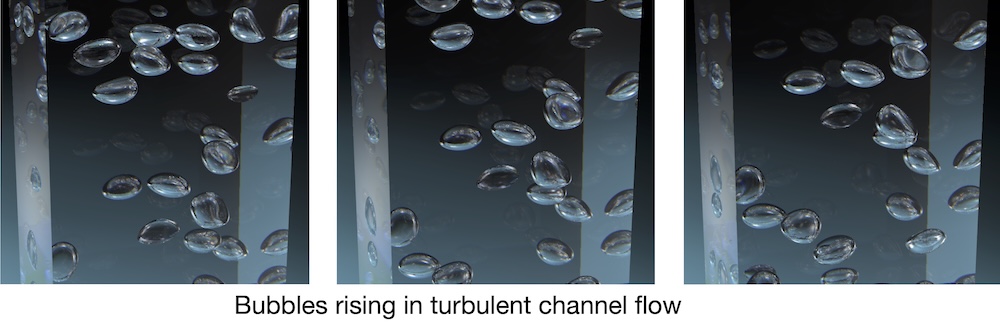
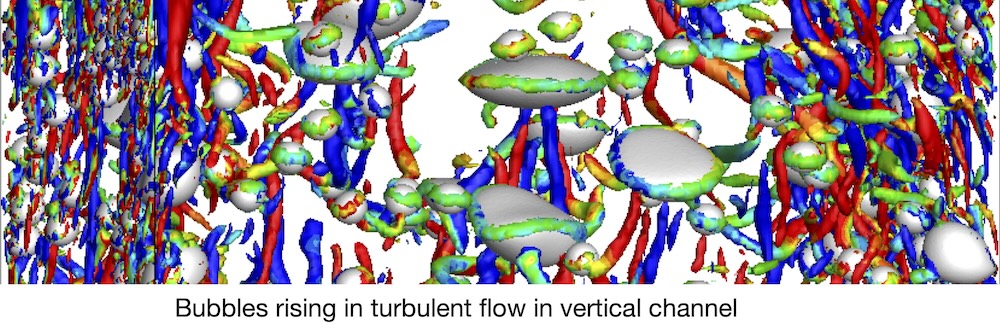
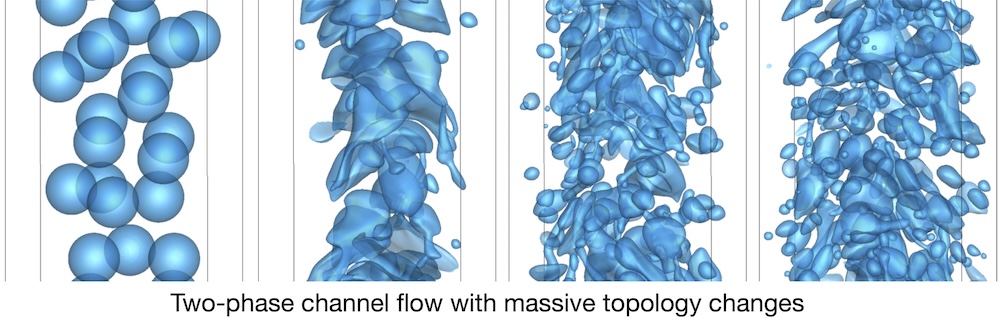
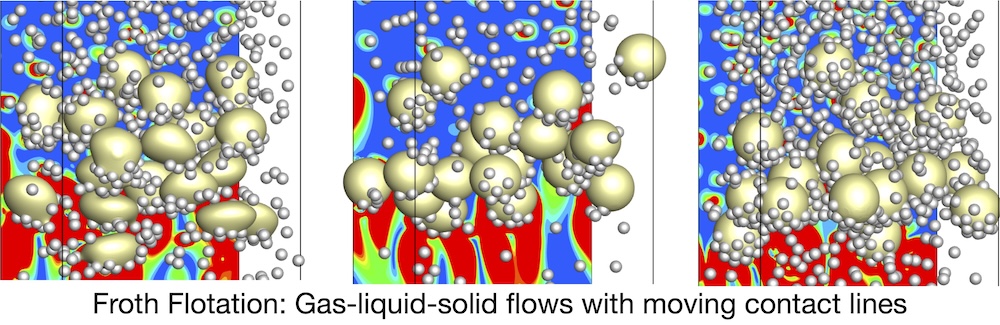
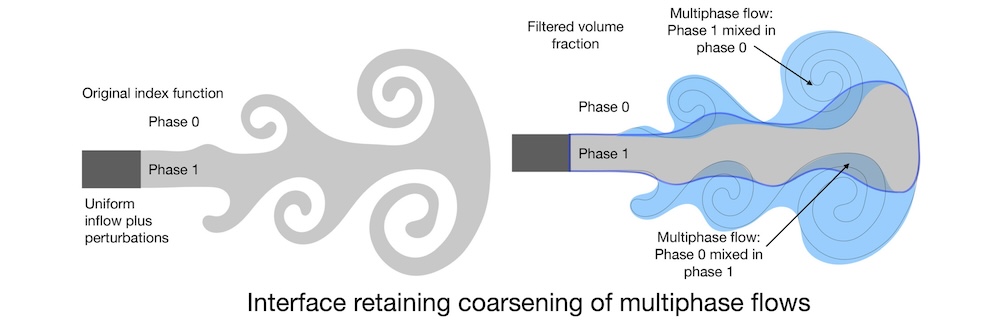
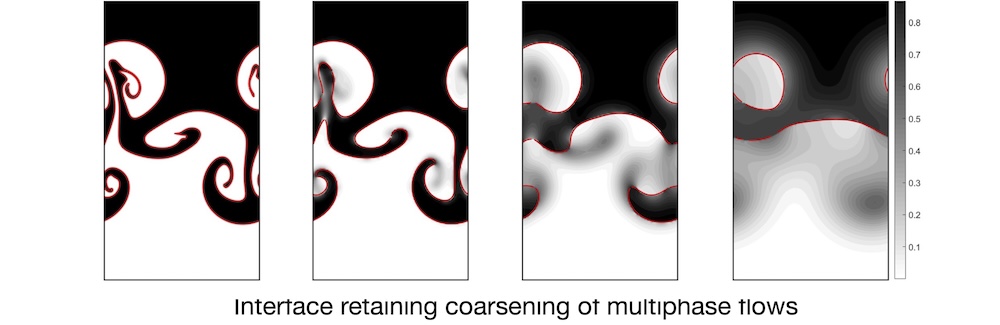
Multiphase flows are an integral part of a large number of industrial processes of
current interest. As new strategies are introduced to produce environmentally
benign fuels, increase recycling, use current resources more efficiently, manage higher
heat loads, increase production of food and feed, manufacture complex objects, and
pull CO2 from the atmosphere, understanding, predicting, and controlling their behavior
will therefore be of ever greater importance. Over the last few decades, direct numerical
simulations, where every continuum spatial and temporal scales are reproduced for large
and complex systems, have greatly increased our insight and understanding. Current
success opens up the opportunities to examine even more complex problems and many current
and future industrial processes involve tightly coupled physical processes taking place on widely
different scales. Even when each process is well understood, their collective behavior
remains poorly understood and can only be predicted by simulations of the whole system.
Numerical Simulations
 Direct numerical simulations of multiphase flows go back to the very beginning of
computational fluid mechanics and as the field has advanced, many possible strategies
to simulate those systems accurately and efficiently have been explored. In some cases
the majority of practitioners have conclusively converged on certain strategies, such
as the use of the one-field, or one fluid, formulations of the governing equations, but
for other aspects various groups remain committed to historical approaches, even when
better methods are available. As the need to consider more complex systems becomes more
urgent, making the most versatile and accurate approaches available to the largest number
of researchers must become a priority.
Direct numerical simulations of multiphase flows go back to the very beginning of
computational fluid mechanics and as the field has advanced, many possible strategies
to simulate those systems accurately and efficiently have been explored. In some cases
the majority of practitioners have conclusively converged on certain strategies, such
as the use of the one-field, or one fluid, formulations of the governing equations, but
for other aspects various groups remain committed to historical approaches, even when
better methods are available. As the need to consider more complex systems becomes more
urgent, making the most versatile and accurate approaches available to the largest number
of researchers must become a priority.
Numerical Methods
 The key to our ability to simulate a wide variety of multiphase flows is the front
tracking method introduced in a 1992 Journal of Computational paper.
As in many other methods, the conservation equations are solved on a fixed, usually
structured, grid and the different phases or fluids identified by a marker or index
function that moves with the fluid velocity. Advecting the marker function on the
fixed grid is surprisingly challenging and several ways have been proposed to do so.
We bypass those challenges by tracking the phase boundary using a separate, usually
unstructured, grid and construct the marker function from the interface grid. This
results in an accurate and versatile method that has been successfully used to
simulate a very large number of multiphase systems, in many cases for the first time.
Here is a simple introduction
to the method, using Matlab codes for 2D flows. For more details, including references
to extensions to flows with heat transfer, phase changes (boiling and solidification),
surfactants,chemical reactions, electric fields, and other physical processes, click here.
The key to our ability to simulate a wide variety of multiphase flows is the front
tracking method introduced in a 1992 Journal of Computational paper.
As in many other methods, the conservation equations are solved on a fixed, usually
structured, grid and the different phases or fluids identified by a marker or index
function that moves with the fluid velocity. Advecting the marker function on the
fixed grid is surprisingly challenging and several ways have been proposed to do so.
We bypass those challenges by tracking the phase boundary using a separate, usually
unstructured, grid and construct the marker function from the interface grid. This
results in an accurate and versatile method that has been successfully used to
simulate a very large number of multiphase systems, in many cases for the first time.
Here is a simple introduction
to the method, using Matlab codes for 2D flows. For more details, including references
to extensions to flows with heat transfer, phase changes (boiling and solidification),
surfactants,chemical reactions, electric fields, and other physical processes, click here.
Here is a Bibtex File with journal papers, book chapters, Ph.D. Dissertations and conference papers. The list of conference papers is very incomplete.
Last updated 6/24/2025 by Gretar Tryggvason